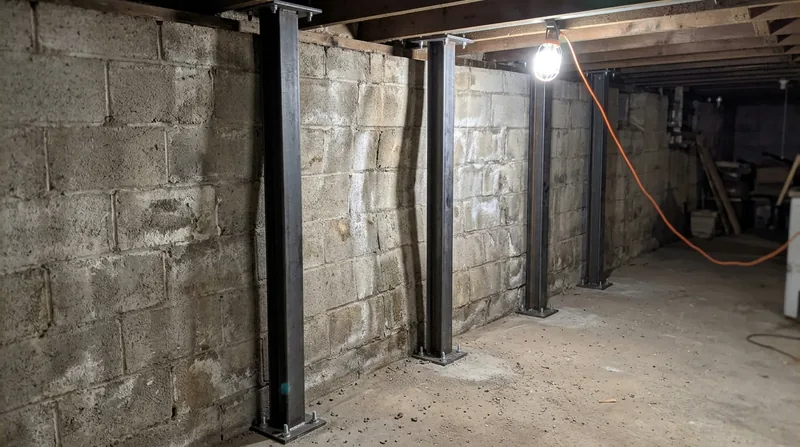




Billings sits on a stack of geology that punishes basement walls. Downtown, Northside and Southside bungalows from the 1900s to 1940s were built with stone, brick or early block foundations, and the benches above the river terraces rest on swelling shale clay that takes on water and pushes. When spring snowmelt off the Beartooth and Crazy Mountains raises the water table, or a summer thunderstorm dumps fast runoff off the sandstone rimrocks, that clay swells and the pressure lands on the wall. If you are searching for Bowing Wall Repair in Billings, you already know the symptom: a wall that leans in, a horizontal crack at mid-height, doors that stick, or a floor that feels out of level. We diagnose the movement, match the fix to the soil and the severity, and stop the wall from going further. Start with a free basement inspection so we can read the wall before anything gets anchored.
Why Bowing Walls Are Common in Billings' Older Basements and Bench Lots
The failure mode here is not mystery water. It is hydrostatic pressure from wet shale clay and frozen ground pressing against block and brick walls that were never engineered for it. The 1950s and 1960s brick ranches across the Heights and the older west-side streets have partly finished basements with walls that have been taking that load for sixty years. In Shiloh and Rimrock Heights, walkout basements cut into the hillside see the same pressure from uphill soils.
- Horizontal cracks at mid-wall signal soil pressure, not settlement, and they need structural attention rather than a coat of sealer.
- Walls that lean inward at the top usually mean the floor and joists are holding the wall while the base pushes.
- Stair-step cracking in block walls follows the mortar joints where the wall is weakest under load.
- Efflorescence and white powder on the wall tell you moisture is moving through the masonry and the soil outside is staying wet.
- Doors and windows that bind on the main floor can indicate the wall has moved enough to affect the frame above.
Sealing a bowing wall without addressing the pressure is a waste of money, and we will tell you plainly when a crack is minor and when the wall itself is the problem.
Key info: A 1950s block ranch off Grand Avenue with a horizontal crack and a two-inch lean at the top is a carbon fiber strap job. A 1920s brick bungalow on the Southside with a bulging stone wall and crumbling mortar often needs steel I-beams and reconstruction before straps go on. Same city, different answer.
Before any structural repair, confirm what your jurisdiction requires. The City of Billings building department governs permits for structural foundation work, and the rules vary by scope, so verify the current requirement at billingsmt.gov before work begins.
How We Diagnose and Repair a Bowing Wall in Billings
We do not quote a method from the driveway. The first step is reading the wall: where the crack runs, how much it has moved, what the soil is doing, and whether the floor system is holding the top of the wall. From there we match the repair to the severity, because a strap on a wall that needs anchors will fail and an anchor system on a wall that only needs straps is money spent for nothing.
- We walk the basement and the exterior grade, check for efflorescence, measure the lean, and note any wall movement at the sill plate.
- We identify the soil condition, from river-terrace gravel and sand to the swelling shale clay on the benches, because that drives the anchor or beam design.
- We relieve the water pressure first where needed, often with an interior drain tile system that captures water at the footing before it loads the wall.
- We install carbon fiber straps, steel I-beams or wall anchors, set into the footing and tied to the floor system, and we torque and document the installation.
- We repair the wall surface, parge or seal as needed, and leave you with a clear record of what was done and what to watch.
The order matters. Relieving pressure after anchoring a wall can leave the anchors carrying load they were not set for, so we sequence the work around the water first.
Key info: A Lockwood tri-level with a leaning block wall and a wet floor got interior drain tile and a sump basin first, then carbon fiber straps once the wall stopped moving. Doing it in that order kept the straps from fighting active pressure from the shale clay.
Bowing Wall Repair Methods We Use and When Each One Fits
No single method covers every wall. The table below is how we match the repair to the movement, the wall material and the soil, and it is the same logic we use on site.
| Approach | Description | Best for |
|---|---|---|
| Carbon fiber straps | High-strength straps bonded vertically to the wall and anchored to the floor and sill, holding the wall against further inward movement. | Block or poured walls with moderate bowing and horizontal cracking. |
| Steel I-beams | Vertical steel beams set against the wall and tied into the footing and floor structure to resist heavy soil load. | Severe bowing, tall walls and older brick or stone foundations. |
| Wall anchors | Earth anchors set outside the wall, connected through the wall to interior plates that pull and hold the wall back toward plumb. | Walls that have leaned but not bulged, where access outside allows anchoring. |
| Epoxy or polyurethane injection | Injection ports feed resin into cracks to close them and stop water movement through the wall. | Non-structural cracks where the wall itself has not moved. |
| Drainage correction | Interior perimeter drain, footing drain repair and grading to remove the pressure source before or alongside structural work. | Walls loaded by a high water table or wet shale clay. |
We will recommend the least invasive method that actually solves the movement, and we will say so when a wall only needs crack injection and drainage correction.
Bowing Wall Repair Cost in Billings: What to Expect
Pricing for this work starts at $600 for the smallest scope, such as a single crack injection, and climbs with the method and the wall. Carbon fiber straps on a typical block wall run well above that, and steel I-beams or wall anchors on a severely bowed brick or stone foundation are a larger job because of the engineering and the excavation or interior work involved. The number depends on the wall length, the amount of movement, the soil, and whether drainage has to be corrected first.
A wall that has moved two inches needs a different budget than one that has moved a quarter inch. Access matters too: a walkout in Rimrock Heights with an open uphill face is easier to work than a Downtown bungalow with a party wall and a finished basement. We put the method, the linear footage and the drainage scope in writing so you can compare like for like. See the full breakdown on our pricing page.
Get two or three estimates and make sure each one names the method and the cause. A quote that only seals the crack without addressing the pressure is not the same job, and the cheapest number is often the one that comes back.
Choosing a Bowing Wall Repair Contractor Near Me in Billings
Structural work on a foundation is not a place to hire on price alone. You want a contractor who is licensed and insured, who will put the method and the cause in writing, and who will tell you when the wall does not need anchoring. Ask for references from similar walls in similar soil, and ask whether the repair addresses the water that caused the pressure.
- Confirm the contractor is licensed and insured and ask for a certificate before work starts.
- Get at least two or three written estimates that specify the method, not just a total.
- Check references for bowing wall work, not just crack sealing, and ask how the wall has held.
- Ask who pulls the permit for structural foundation work, since the City of Billings building department sets the requirement.
- Understand any HOA or historic-district review that applies before exterior excavation or anchoring begins.
We will walk you through all of it on site and give you a straight answer about what your wall needs. Reach out through our contact page to set up the inspection.
For homeowners in the 59102 ZIP code and the neighborhoods around it, our Bowing Wall Repair in Billings 59102 page covers the local wall types and what we typically find.
Bowing Wall Repair in Billings: Pricing Guide
| Service | Price | Details |
|---|---|---|
| Crack injection (epoxy or polyurethane) | Starting at $600 | Single non-structural crack, includes injection ports and resin; wall length and access move the price |
| Carbon fiber strap installation | Starting at $1,450 | Straps bonded and anchored to floor and sill; wall length and number of straps drive cost |
| Steel I-beam or wall anchor system | On estimate | Severe bowing or brick and stone walls need an on-site look at soil, access and footing condition |
| Drainage correction alongside structural repair | On estimate | Interior perimeter drain or footing drain repair priced after the water source and wall scope are confirmed |
| Travel | Included | In Billings and surrounding areas, no separate call-out or mileage fee |
| Estimate | Free | Response within 24h at (406) 500-5258, no obligation to book |
Indicative pricing, the exact cost depends on square footage, finish, and site access. Free personalized estimate within 24h at (406) 500-5258.


